

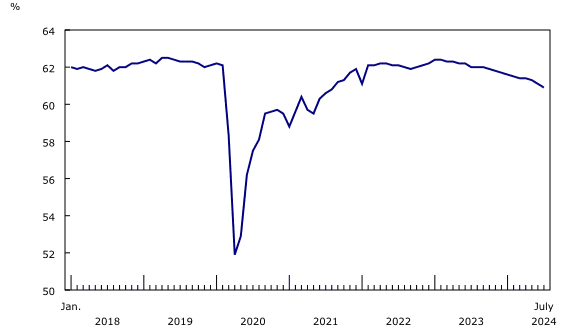
Canada’s unemployment rate held firm at 6.4 per cent in July amid a relatively steady month in the labour market. Statistics Canada said Friday that total employment was “little changed” last month. Some 2,800 jobs were lost in July, the agency said.
That marks the second consecutive month of job losses for Canada after net 1,400 positions were lost in June. But overall, employment is still higher by around 346,000 positions yearoveryear.

1. Labor Market Conditions and Economic Growth
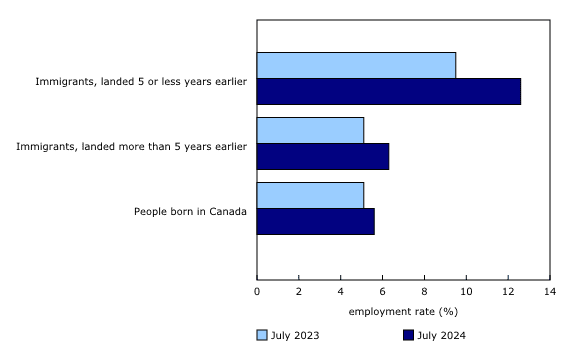
The Statistics Canada notes that the unemployment rate in Canada has risen to 5.5% in July 2024, up from 5.4% in June. It also indicates that the labor market is experiencing a cooling trend with job losses and a rising unemployment rate. The Bank of Canada’s summary of deliberations further emphasizes that the slack in the labor market could delay the rebound in consumer spending, which is critical for economic growth.
Impact on Housing Market
Demand Pressure: A weaker labor market often translates to reduced consumer confidence and spending power, leading to lower demand for housing. With fewer job opportunities and higher unemployment, potential homebuyers may be less willing or able to invest in purchasing a home.
Market Activity: The cooling labor market may also discourage current homeowners from selling, as they might be uncertain about their own employment prospects or feel that they might not get the desired price in a sluggish market.
2. Interest Rates and Inflation
The Bank of Canada’s stance on interest rates is crucial for the housing market. The central bank has signaled its willingness to continue cutting interest rates as long as inflation remains under control, aiming to stimulate economic growth. Currently, the key interest rate sits at 4.5%, with further cuts anticipated if economic conditions don’t improve.
Impact on Housing Market
Mortgage Rates: Interest rate cuts typically lead to lower mortgage rates, which can make home loans more affordable and stimulate demand in the housing market. This could potentially counteract some of the negative impacts of the weak labor market by making borrowing cheaper for homebuyers.
Affordability and Refinancing: For existing homeowners, lower interest rates provide an opportunity to refinance their mortgages at a lower cost, potentially easing financial burdens, especially for those facing economic challenges due to the weaker job market.
Investor Behavior: Lower interest rates can also attract investors to the housing market, seeking better returns compared to other investment avenues, further driving demand.
Overall Impact on Ontario’s Housing Market:
In Ontario, these factors will likely have a mixed impact on the housing market:
ShortTerm Softening: The labor market’s weakness may initially soften demand for housing, leading to slower sales activity and potentially stabilizing or even lowering home prices in the short term.
Potential Uptick in Demand: However, if the Bank of Canada continues to reduce interest rates, the housing market might see an little uptick in demand as mortgage rates become more attractive making cost of borrowing little less. This could lead to increased buying activity, particularly among those looking to capitalize on lower borrowing costs.
How it will affect House Prices:
In light of the above factors, the trajectory of house prices in Ontario will be influenced by the interplay between weakening labor market conditions and potential interest rate cuts by the Bank of Canada. Here’s a breakdown of the likely scenarios:
1. Short-Term Stabilization or Decline in Prices:
- Weak Labor Market Impact: With rising unemployment and reduced consumer confidence, demand for housing may decrease in the short term. Fewer people may be willing or able to purchase homes, leading to reduced competition among buyers. This could stabilize house prices or even cause a slight decline, especially in areas or segments of the market where demand has been particularly sensitive to economic conditions.
- Economic Uncertainty: As the labor market softens, potential buyers might adopt a wait-and-see approach, further dampening demand. Sellers might also be forced to lower prices to attract buyers in a slower market.
2. Potential Support for Prices from Lower Interest Rates:
- Interest Rate Cuts: As the Bank of Canada continues to cut interest rates to stimulate economic growth, mortgage rates are likely to decrease. Lower mortgage rates could make borrowing more affordable, potentially reinvigorating demand for housing.
- Increased Affordability: For some buyers, the combination of slightly lower home prices and reduced mortgage rates might make it an opportune time to enter the market, which could help support or even stabilize prices.
- Investor Activity: Lower interest rates could also attract investors to the housing market, providing additional support for prices. Investors may see real estate as a more attractive option compared to other investments with lower returns.
3. Regional Variations:
- Urban vs. Rural: The impact on house prices might vary across regions in Ontario. Urban areas, where prices are already high and more sensitive to economic changes, may experience more significant price adjustments compared to rural or less densely populated areas.
- High-Demand Areas: In high-demand areas, such as Toronto, the impact of lower interest rates might be stronger, potentially maintaining or even slightly increasing prices despite broader economic challenges.
Final Words:
The Ontario housing market is poised to experience both downward and upward pressures. The weak labor market may dampen demand and market activity, while anticipated interest rate cuts could stimulate demand and potentially lead to a rebound in the market. The net effect will depend on the balance between these forces, the pace of interest rate cuts, and the overall economic environment in Ontario. Overall, house prices in Ontario are likely to experience mixed effects. In the short term, prices may stabilize or decline slightly due to weaker labor market conditions and reduced demand. However, if the Bank of Canada’s interest rate cuts are substantial and sustained, they could provide enough support to stabilize or even push prices upward, particularly in high-demand areas or among buyers who can take advantage of lower mortgage rates.
The overall direction of house prices will depend on the balance between the dampening effects of a weak labor market and the stimulative effects of lower interest rates.
This Article has been written by Ritesh Jhamb, Broker of Record, Homelife/Paramount Realty.
