

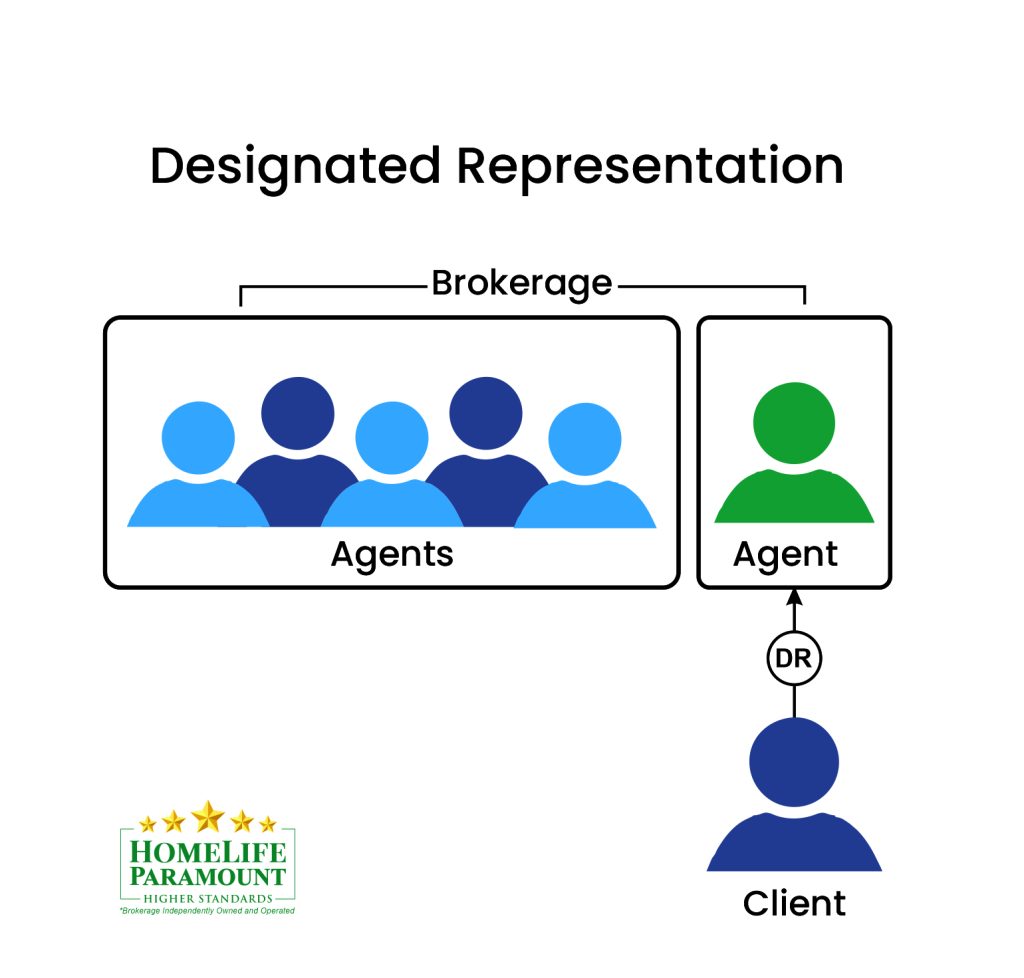
DESIGNATED REPRESENTATION
Under designated representation, the agreement is also with the brokerage. The difference is that the agreement identifies one or more agents as the “designated representative” for the client.
The “designated representative” is the agent that will provide representation to the client. Put another way, the designated representative is the agent responsible for promoting and protecting the best interests of that client.
The designated representative is also responsible for protecting the confidential information of the client. This means confidential information, such as the client’s motivation to buy or sell and their financial circumstances, must not be shared with any agent who is not a designated representative for the client. The brokerage, and all other agents employed by the brokerage, are neutral parties. In addition to other duties under the legislation, the brokerage has specific responsibilities under designated representation.
- The brokerage must protect each client’s confidential information. This includes ensuring that a designated representative does not disclose the client’s confidential information to any other agent employed by the brokerage or other person, unless the client provides written consent, or the disclosure is required by law.
2. The brokerage must treat the interests of clients that have entered into designated representation agreements in an objective and impartial manner.
3. The brokerage is still responsible for supervising every designated representative to ensure they fulfill their duties under the designated representation agreement.
4. In the event that a designated representative is not able to represent a client, the brokerage must designate a different agent employed by the brokerage to be the designated representative for the client if the client agrees to the new arrangement.
Designated representation is distinctly different from brokerage representation, where the brokerage and all its agents are representing the client under the brokerage representation agreement. Who receives and has access to confidential client information, such as the client’s motivation to sell or buy, is also an important distinction between the two types of representation. Under designated representation, the designated representative is the only agent who is permitted to have access to the client’s confidential information.
MULTIPLE REPRESENTATION UNDER DESIGNATED REPRESENTATION


If each of the brokerage’s clients are under designated representation agreements, multiple representation will only arise when the same designated representative is representing more than one client in the same trade.
Example:
Christie and Raj work for the same brokerage. Christie is the designated representative for the seller. Raj is the designated representative for the buyer.
Raj’s buyer client expresses an interest in Christie’s seller client’s property. Because each client isrepresented by a different designated representative, it is not multiple representation. There is no change in the services or representation that Christie and Raj can provide to their respective clients.
Christie and Raj can continue to promote and protect the best interests of their respective clients in the trade. Christie can advise her seller client on the price to accept, the terms to include in the APS and other matters. Raj can continue to advocate for his buyer’s interests, advising the buyer on the amount to offer and the terms to include in the offer.
SOME FREQUENTLY ASKED QUESTIONS FOR MORE CLARITY :
Can there be more than one designated representative?
The designated representation agreement may identify more than one designated representative. The designated representative is prohibited from sharing confidential client information. Where two or more agents routinely share confidential client information, each of the agents should be identified as designated representatives under the agreement.
For example, an agent has another agent working as an assistant, sometimes referred to in the industry as a “licensed assistant”. Confidential client information is shared between the two agents. In this situation, the designated representation agreement should identify both agents as the designated representatives for the client. This would permit the sharing of information to continue.
Another situation where this might be necessary is in relation to “teams”. While teams aren’t recognized under the legislation, the same rules would apply. All agents who might have access to or might discuss the client’s confidential information should be identified as designated representatives under the agreement.
Brokerages should consider policies to address these types of situations if they choose to adopt
designated representation. Likewise, agents should ensure they are following any brokerage policies.
Where agreements identify more than one designated representative, additional monitoring is required to ensure that multiple representation is identified and addressed appropriately.
If I am the designated representative, who can take care of my client if I am away on vacation
or get ill?
The brokerage, in consultation with the client, can designate another agent within the brokerage to act on the client’s behalf for the period of time you are away or otherwise unavailable. Alternatively, the designated representation agreement could name more than one designated representative at the time the agreement is entered into. All designated representatives named in the agreement are bound by the same duties, regardless of whether or not they are providing services to the client.
If I am the designated representative, and I move to a different brokerage, does the client move with me?
The designated representation agreement is with the brokerage, not the designated representative. The brokerage would designate a different representative, subject to the client’s consent.
What does the brokerage need to do if it wants to transition to designated representation?
Brokerages will need to establish written policies and procedures related to information barriers that support the introduction of designated representation, the protection of confidential client information, and other matters, such as whether or not a backup designated representative is identified in the agreement or addressed when required. Brokerages will need to make sure that all of their agents, and other brokerage employees, are using the right type of representation agreement, understand how confidential client information must be protected, and are aware of any other brokerage requirements related to designated representation.
Where possible, brokerages who want to operate under designated representation should consider having their existing clients enter into designated representation agreements to avoid any confusion. For many brokerages, this will be easier than having to monitor which form of representation each client is under and in which circumstances multiple representation arises.
