

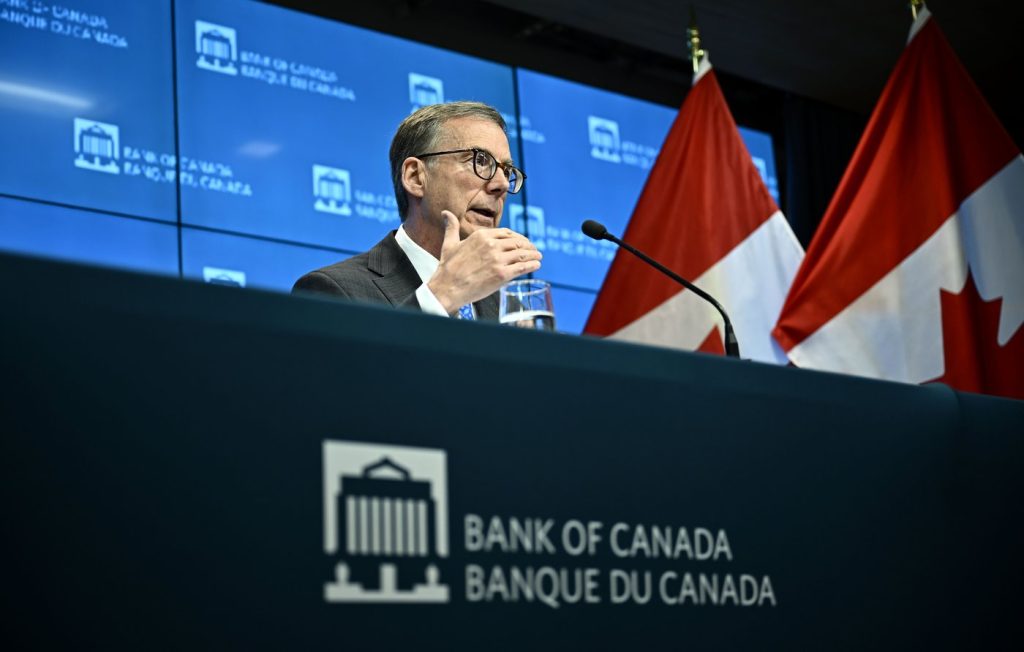
RATE CUT EXPECTED ON 4TH SEPTEMBER BoC ANNOUNCEMENT
The Bank of Canada is expected to lower interest rates for the third consecutive time on Wednesday, September 4th, continuing its strategy to reduce borrowing costs. Economists and investors largely predict the central bank will reduce its benchmark interest rate by 0.25 percentage points to 4.25 percent, with additional cuts expected throughout this year and into 2025.
With inflation nearing the bank’s 2-percent target, rising unemployment, and declining per-capita consumption, there are compelling reasons for a reduction in rates. Additionally, the U.S. Federal Reserve is approaching its own cycle of rate cuts, easing pressure on the Bank of Canada to diverge from its American counterpart.
While Wednesday’s decision is likely to meet expectations, financial analysts will be closely monitoring for indications of the speed and extent of future rate cuts by the Bank of Canada, including the possibility of larger reductions.
“Clearly, rates need to be lower than they are now, and the bank is moving slowly and surely in that direction,” noted Benjamin Reitzes, a Canadian rates and macro strategist at the Bank of Montreal.
In the previous rate announcement in July, Bank of Canada Governor Tiff Macklem indicated that the central bank’s governing council was increasingly concerned with “downside risks.”
“We need growth to pick up so that inflation doesn’t fall too much, even as we work to bring inflation down to the 2-percent target,” Macklem stated.
This change in the bank’s communication has strengthened expectations that it will continue lowering rates without pause. Market instruments, such as interest-rate swaps, currently predict six more quarter-point cuts by mid-2025, potentially bringing the benchmark rate down to 3 percent, according to Bloomberg data.
Investors also anticipate that the U.S. Federal Reserve will begin cutting rates at its meeting on September 18. These expectations were bolstered by a recent speech from Fed Chair Jerome Powell at the Jackson Hole economic conference, where he remarked, “The time has come for policy to adjust.”
Canada’s economy has shown weak performance over several quarters, with softened demand as consumers and businesses face higher borrowing costs. The unemployment rate has climbed to 6.4 percent, nearly two percentage points above the historic low recorded two years ago.
These factors have contributed to a decline in inflation, with the Consumer Price Index rising at an annual rate of 2.5 percent in July, the lowest level in over three years. Inflation has remained within the Bank of Canada’s target range of 1 to 3 percent for seven consecutive months.
“The focus now is on the labor market and the pace of economic growth,” said Royce Mendes, head of macro strategy at Desjardins Securities. “Inflation is now more of a back-burner issue.”
Despite economic weakness, Canada has so far avoided a recession. However, rapid population growth has propped up aggregate figures like gross domestic product (GDP), masking a decline in GDP per capita, a key indicator of living standards.
“You could argue that the economy has performed much worse than the headline numbers suggest,” Reitzes said.
The Bank of Canada expects economic growth to pick up in the second half of the year and strengthen through 2025 and 2026 as lower rates provide more room for consumer and business spending. However, a significant risk remains: mortgage renewals. Even with a trend towards lower rates, many homeowners will face higher mortgage rates than in 2020 and 2021, leading to increased payments.
“It’s a significant reason why the Bank of Canada needed to start this rate-cutting cycle early and must lower rates further before the mortgage renewal peak in April 2025, five years after rates were near zero,” Mendes explained.
Mendes added that he will closely analyze Macklem’s comments on Wednesday for any hints that the Bank of Canada might consider a half-point rate cut in future meetings, although he is not yet convinced this will happen.
However, if the labor market deteriorates substantially and other central banks also ease monetary policy, “the Bank of Canada will feel more comfortable making a larger cut if that’s what’s needed,” he concluded.
Housing Market Outlook If the Bank of Canada Cuts Interest Rates:
If the Bank of Canada proceeds with an interest rate cut on September 4th, the housing market could experience several key impacts:
- Increased Demand for Housing:
Lower interest rates typically reduce the cost of borrowing, making mortgages more affordable for homebuyers. This could spur increased demand in the housing market, particularly among first-time homebuyers and those looking to upgrade. The reduction in rates could also encourage existing homeowners to refinance their mortgages, potentially freeing up additional spending power. - Potential Stabilization of Home Prices:
With more buyers entering the market due to lower borrowing costs, home prices could stabilize or even rise modestly in certain regions. This would mark a shift from the recent cooling trend observed in many Canadian cities, where higher interest rates had dampened buyer enthusiasm and slowed price growth. - Boost to Housing Market Confidence:
A rate cut could boost overall confidence in the housing market, encouraging both buyers and sellers to engage more actively. Real estate investors, who often react sensitively to changes in borrowing costs, might also see renewed interest, particularly in markets that have shown resilience or potential for growth. - Variable Rate Mortgages Become More Attractive:
Lower interest rates generally make variable-rate mortgages more attractive relative to fixed-rate mortgages. This shift could lead to a higher proportion of homebuyers opting for variable-rate options, betting on continued rate cuts or stable low rates in the near future. - Long-Term Considerations:
While a rate cut may provide immediate relief and stimulus to the housing market, there are long-term considerations to keep in mind. For instance, if inflation remains contained and the economy shows signs of recovery, the Bank of Canada may eventually slow down or halt its rate-cutting cycle, which could impact future housing market dynamics. - Risks Associated with Higher Mortgage Renewals:
Despite potential short-term gains in the housing market, the upcoming wave of mortgage renewals at higher rates remains a concern. Many homeowners will be transitioning from ultra-low rates seen in 2020 and 2021 to comparatively higher rates, which could strain household finances and affect housing affordability, even in a lower-rate environment.
Overall, while a rate cut on September 4th is expected to provide a short-term boost to the Canadian housing market, the outlook will depend on broader economic conditions, future rate cuts, and the central bank’s approach to managing inflation and growth. The Bank of Canada’s ongoing communication and policy direction will continue to play a pivotal role in shaping housing market expectations.
